
Threshold crossed, commence act two. Here we'll see our protagonist, Neo, face numerous challenges, both external and internal. Although that really means they're all external - this is a movie, after all.
Act Two
11. Nebuchadnezzar's crew - Neo's muscles are rebuilt, he opens his eyes for the first time, and meets the freedom fighters

Neo is slowly adjusting to this new world and this sequence takes its time. The Wachowski's do not overload us with information, instead providing answers one question at a time. They address logical gaps in the mythology, the first being Neo's physical body: having never really used any part of it, his muscles have wasted away and he's never even used his eyes. He's being rebuilt on a literal, physical level that complements the metaphorical rebirth.
There are a number of influences in The Matrix. It's a collection of numerous philosophies and literature, all gathered together to make an original piece that honors its parents. So far, those parents have mostly been classic books, the cyberpunk genre, and philosophical concepts. In this act, the Asian influence becomes really pronounced.
You might think the Asian aesthetic lies with the action sequences, particularly since renowned martial arts choreographer Yuen Woo-ping made the fights in The Matrix come alive, but you'd be wrong. Notice the giant needles Neo is punctured with to rebuild his muscles? If that's not an acupuncture allusion, I'll eat one of those needles!
"You've never used them before."
12. The real world - Neo learns the true nature of the Matrix
What time is it? It's Adventure Exposition Time!
Information is always difficult to disclose in a movie. You risk having a character ramble endlessly, spouting words, words, words that bore even the most patient person. The trick to exposition is to mask it: bake it into a delicious cake that, unknown to the audience, is filled with the vegetables a growing kid needs. It's sleight of hand, an ability both magicians and writers must have. And bakers, apparently.
As I said before, Morpheus is the character who divulges information about the world of The Matrix. The exposition here works because even though the dialogue itself is pretty straightforward, it's presented with a bow. There's a flair to what Morpheus says that's part of the mask.
In addition to Fishburne's voice, the visual images accompanying his lesson are intriguing and satiate the eyes. Remember: sight and sound isn't just an NYU film class (please don't kill me), but the two senses at work when watching a film. When they work together you get wonderful cinema.
Finally, since Neo is just as in the dark as we are, it makes logical sense that he'd have to be straight up told what's going on. The first act was spent casting riddles, like Bilbo and Gollum do on their days off, and it hooked him and us. Now that we've all decided to cast our lot with Morpheus (or the Wachowski's), he (they) must follow through with answers - which we finally have.
"Welcome to the desert of the real."
13. The search is over - Neo learns he can't go back and what Morpheus is really after
A short scene but an important because Morpheus reveals what he's been searching for and, in turn, reveals the stakes of the film. Morpheus believes he's found the savior, the messiah, who will lead the humans from their prisons and venture forth into the light. It's a moment of consolation mixed with exposition that tells us the fate of all humanity will be in Neo's hands.
No pressure!
"As long as the Matrix exists, the human race will never be free."
14. Training begins - Neo learns of Zion and begins his training
We come, once more, to a scene that at first glance appears unimportant. But, as before, this is far from the truth. Despite the brevity of this scene, it's a vital stepping stone in Neo's journey because it provides Neo with hope: the existence of Zion.
The symbolism and metaphors at the core of this scene augment the story's bank of references, themes, and meanings. In addition, it provides Neo with a far-off goal. At this moment, the city is mythological because we've not seen it. But, should Neo succeed, his reward will be contact with the last bastion of mankind. It's not the explicit goal the Wachowski's have given Neo and the city is a very minor plot point, but it exists nevertheless. Neo now knows he has a home to go to, a hearth with which to warm himself. It's this hope that makes the task of rescuing the humans from the Matrix far from an impossible goal.
Enough talk! Let's get down to how Neo will save the human race: with super cool martial arts moves.
"If the war were over tomorrow, Zion's where the party would be."
15. Morpheus/Neo matchup - Neo spars with Morpheus, learning that rules can be bent and broken

This scene goes on for over six minutes. It does not go on this long in the script. The Wachowski's aren't writing six pages worth of punches and kicks in a dojo, but overindulgence this is not.
In a good movie, fight scenes are not just meant to wow audiences with gravity-defying stunts. Instead, the fights are internal conflicts made external. They grasp an aspect or two of the overarching themes that are seen in the protagonist and show them to us visually. In this scene, Morpheus teaches Neo that the rules of the Matrix can be bent and some even broken. He means, literally, that Neo can throw a punch much faster than Bruce Lee and kick through a solid wall but he also means that rules can be broken. That's a central theme in The Matrix, as evidenced by a band of rebels rebelling against the establishment.
Every strike is ripe with meaning. Mouse is amazed at Neo's speed, which hints he might, indeed, be the One. Of course, we're also shown Neo's newbieness. In the first part of the match, he shows off, taunting Morpheus. It comes to a crashing conclusion when he runs up a beam, somersaults into the air, and lands behind Morpheus only to be sent flying into another beam. Only after failing and gaining wisdom can the student the best the teacher.
It's a training sequence not unlike Luke's by way of Obi-Wan.
"You think that's air you're breathing now?"
16. First jump - Neo tries to free his mind but falls instead
Doubt creeps in. Neo fails his first jump, leaving a bewildered Mouse to ask what that means. The others tell him it means nothing, since everyone falls their first time. But shouldn't the One defy the status quo?
If the previous scene gave us hope for Neo's success, this one undermines it by giving us that first bit of doubt. And how poetic that said doubt segues into a moment with Cypher, the Judas to Neo's Jesus. In his short moment with Trinity, we're presented with a butt-load of information in a nice confrontation. Cypher clearly lusts after Trinity, as proven by his opening remark. That line serves another purpose, as it shows us that Trinity is behaving differently with Neo. Perhaps she's taken a liking to him?
This is a good scene: it moves the protagonist along on his journey while spinning the wheels of the subplots.
"Free your mind."
17. The gatekeepers - Neo learns about the Agents
I was always horrified that the rebels could so easily kill security guards and other bluepills that remain part of the Matrix. I mean, it's one thing to kill a sentient program but it's quite another to kill a fellow human being - one enslaved by machines, no less! The training program involving the woman in the red dress explains to the audience, and Neo, why collateral damage is okay: they simply pose a threat to the greater good.
Since the bluepills are part of the system that is the Matrix, the malevolent Agents can morph into them and wreck havoc on the redpills. Poor Neo learns that everyone who has stood their ground and fought them has died and that someone, i.e., him, must defeat them.
Pressure rising and rising...
Though we've seen Agents before, they are now contextualized. We understand who they are, what they are, and why they are. Though the explanation is verbal, that most damnable mechanism of exposition, it's backed up by visuals that accentuate it. The black-dressed throng (many of whom are actually twins and triplets, to provide that sameness feel) bumps into Neo, becoming a literal obstacle. It's all about masking the hand of the writer.
"What are you trying to tell me? That I can dodge bullets?"
18. Running silent and deep - Sentinels are detected and Neo sees them up close
Well, good thing the Agents are just programs inside the Matrix. They can't hurt us outside of it! Phew, time to relax and have a nice cup of post-apocalyptic tea...oh shit!
The rebels just can't catch a break! Not only is there danger inside the simulation, but outside of it they are hunted down by the sentinels, squid-like machines whose sole purpose is to seek and destroy. The only way to destroy them is to set off an EMP (foreshadowing!) but that has its drawbacks. In this half of act two, conflicts like this need to be constantly thrown at the protagonist so that he or she has obstacles to overcome, otherwise we'll have not just a short film but an empty one, as the resolution would otherwise occur too easily.
Life really sucks for humans in the year 2199.
"There used to be cities that spanned hundreds of miles. Now these sewers are all that's left."
19. Dealing for bliss - Neo talks to Cypher, who then makes a deal with Agent Smith

I've always found it interesting that Cypher has no problem being completely honest with Neo. Cypher hates the real world and explicitly states it when he says he's thinking, ever since he was unplugged, "why, oh why, didn't [he] take the blue pill?" And then a few minutes later, he's dining with Agent Smith and brokering a deal to give up Morpheus in return for getting plugged back into the system.
But his reasoning is valid! Here he is, in the real world, pursued by killing machines, attracted to a woman who doesn't care for him, and living on meager rations in the sewers. Who would genuinely choose that life when they could live a better one?
The question, then, is which is better: the horrible but real world, or the wonderful but fake world?
Here's an example of dramatic irony and conflict: a future betrayal is guaranteed that will likely throw everything Morpheus has planned for Neo under a bus.
(How amusing is it when Cypher exclaims "Jesus!" after Neo says Morpheus believes he's the savior? Mildly amusing!)
"Ignorance is bliss."
20. Off to see the oracle - Neo is offered a date with the woman in red but is set up on one with the Oracle
To give further credence to Cypher's previous point, we're shown the rather disgusting-looking goop that passes for food aboard the Nebuchadnezzar - immediately after being shown a delicious steak! Perhaps ignorance really is bliss...
This scene serves as a transition to the meeting with the Oracle, but the Wachowski's pad it with some more poignant philosophical discussion that stems directly from Cypher and Agent Smith's chat. Did the machines really get the taste of Tastee Wheat correct? The world may never know - especially because it's not a real product.
In a way, this scene serves as a counterpoint to the previous one. Yes, the Matrix makes us believe that that piece of steak is delicious but it's still not real, so who knows how legitimate the taste is? Perhaps it doesn't matter, as Dozer notes, as long as the food provides the nutrients the body needs.
"Maybe they couldn't figure out what to make chicken taste like, so it's why chicken tastes like everything."
21. There is no spoon - Neo is taken to the Oracle and learns a truth about the Matrix
This is the first time Neo enters the Matrix after having been unplugged. Naturally, it feels weird; the world outside seems slower and strange. In fact, it's so odd for him that he feels like an outsider and this is perfectly captured, visually, by the fact that he's driving through in a car, staring out the windows.
We, too, see this world differently. We're now conscious of its deceptive nature.
Adding to the Wachowski's cultural references, we have the room of potentials. This group of telepaths, lifting blocks through the air and bending spoons, reminds me of the espers from Akira. They're also watching Night of the Lepus on the TV, though having never seen what I assume is the magnum opus of cinema, I can't comment on it. Maybe it's just a rabbit motif. This is how stories work, though: references upon references because art doesn't live in a vacuum, it speaks to works that have come before.
Script notes: in the 1996 draft, this section was extremely convoluted. It's a hell of a recurring theme: the draft is much more fluffy than the final piece, which is much stronger. Originally, the Oracle resides in a huge temple complex guarded by numerous guardians. It's much more grandiose than the simple imagery presented here: the Oracle as a grandmotherly figure, baking cookies. Simple, cost-effective, and much more powerful.
"There is no spoon."
22. Choices...and a cookie - Neo is not the One, but gets a cookie
Ah, the legendary oracle - we meet at last. The set-up of the scene is very simple, which is why it works so well: it's just an older woman baking cookies and dishing (ha!) out advice. No fancy temples, no computer-generated effects, just two people, in a room, talking.
And we begin the talk with a joke: the broken vase. Here, the Wachowski's are throwing another philosophical bone into the discussion but it's so minor and delivered so nonchalantly that it becomes a joke. It's the Wachowski's poking fun at the whole philosophy of the Matrix by adding another, almost absurd, thought-provoking idea.
But it's the foreshadowing that's important. I mean, if you have an Oracle, you may as well get your money's worth, right? Her minor prophecy is completely truthful: at no point does she make a statement that does not come about - and that's fascinating.
In a way, the Wachowski's explicitly lay out the rest of movie and even tells us how it ends. We're told a woman has a crush on Neo and I would hope that the audience isn't as dense as the savior of mankind is and knows who the woman is, that Morpheus will sacrifice himself for Neo, and that Neo will have to decide whether he or his teacher will die.
Most importantly, and frightening, the Oracle tells Neo that he is not the One, that he has the gift but is waiting for something. "Your next life maybe, who knows." You do, you damn Oracle! And boy, is she right.
Then again, the reason Morpheus gives himself up and Neo eventually dies rescuing him is because the Wachowski's wrote it that way. So to discuss free will in a story is kind of ironic...
"You'll remember that you don't believe in any of this fate crap. You're in control of your own life. Remember?"
23. Glitch in the matrix - The Agents make a change and draw first blood
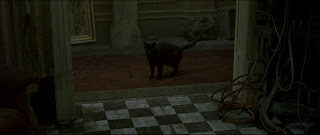
Black cats foretell ruinous news.
The Wachowskis escalate the action now as we reach the midpoint of the story. The siblings are really good at dropping minor ideas as plot points. Using déjà vu to explain how the Matrix can be altered is great. I bet a bunch of people who watched this movie now freak out when they experience it.
We know something heavy is going down for two key reasons (besides the many men with guns): Morpheus takes off his trench coat, and Neo is given a gun. That, readers, means it's business time - the killing kind. Small details speak volumes.
Poor Mouse. If only that cat hadn't shown up...
"A déjà vu is usually a glitch in the Matrix. It happens when they change something."
24. One left behind - Morpheus sacrifices himself to get Neo out
Like Obi-Wan before him, Morpheus sacrifices himself for his student (and to a man in a black suit, no less). It's another notch in the monomyth, like everything the Oracle told Neo would come to pass. Prophecy numero uno complete.
Interesting tidbit: when Morpheus asks Smith who he is, the agent responds, "A Smith. Agent Smith." I may be reading a bit too much into it, but consider that in The Matrix Reloaded, Smith drives a car with a license plate reading IS 5416, alluding to Isaiah 54:16 in the Bible. That passage reads, "Behold, I have created the Smith that bloweth the coals in the fire, and that bringeth forth an instrument for his work; and I have created the waster to destroy."
Hugo Weaving may have just delivered the line a bit oddly, but I wouldn't be surprised if the Wachowski's had planned it this well.
Directorial remark: I really dig the shot of the rebels climbing down through the walls.
"You must get Neo out! He's all that matters!"
25. Heroes unplugged - Cypher takes over the Nebuchadnezzar and unplugs some rebels
The betrayer finally strikes - with lightning, of all things.
I always wondered why there was a lightning gun aboard the ship. Who the hell are they going to use that against? The Sentinels? Well, that's exactly who, though we find out only in the sequel.
We've reached the midpoint of the story. It's the lowest point in Neo's journey as he has seemingly lost everything: he's been told he's not the savior he was said to be, he's lost his mentor, and his friends have just been murdered. All he needs now is to be killed himself! Oh, wait, give it time...
"Welcome to the real world, huh, baby."
26. Cypher's burnout - Cypher gets a taste of his own medicine
This scene isn't that disconnected from the previous one. In fact, calling it a completely separate chapter (especially when it's so short) serves little purpose. Still, here we have a shift in the story as just a few seconds ago everyone was dying and the story seemed to be concluding.
Cypher's joke that some sort of miracle must occur to save Neo's life - if he is indeed the One - seems to serve a dual purpose. It's a very good question that tests whether Neo is who he is supposed to be. When a miracle does occur, it's the proof we need to start believing in him.
But this also feels like the writers are writing themselves out of a corner. Tank was shot point blank in the back with a beam that seems as powerful as the one that hit Dozer - and yet the (literally) bigger man is the one who dies? It's always struck me as a weak moment in the script, though it can, and is, easily masked through the miracle card.
"I mean, how can he be the one if he's dead?"
27. Matters of belief - The Agents start to break Morpheus and Neo, refusing to unplug his mentor, chooses to save him instead

For the past ninety minutes, the audience has rooted for Neo and the other rebels. Free the humans! Down with the machines! Now we come to a junction that seeks to throw our previous beliefs out the window. Agent Smith tells Morpheus that the first Matrix was a perfect world, one in which every human had every desire fulfilled, but it was rejected. We humans, who strive to achieve perfection and re-enter Eden, were gifted our dream and we refused it. Says a lot about us, huh?
Back to our hero. What's key here is Neo's decision to save Morpheus' life. It's the Oracle's prophecy coming true (again; damn, she's good), as Neo points out. He sees his destiny before him and chooses to act, to sacrifice himself. Is it really a choice? I'm reminded of the vase the Oracle told Neo not to worry about...
Kick-ass female note: Trinity pulling rank on Neo is hilarious but also further proves how capable she is, while bringing Neo back down to earth. He's made up his spiritual mind and is gung-ho about rescuing Morpheus, but Trinity reminds him that it's not that simple and he'll need help.
There's one final bit of foreshadowing with regard to Neo's Oneness. He tells Trinity he isn't the mythical hero but she says it's not true and has the sweetest eyes as she says it. "Why?" asks our hero, to which he gets no response - only those eyes. Not too bright, indeed.
Good thing his fighting skills are better, as we'll see a couple of scenes from now...
"I believe I can bring him back."
END ACT TWO
We've come a long way from whence we started. So has Neo. We're aware of the rules, aware of the world and ready to break free from it. That's the purpose of act two: to expand on the world introduced in the first ten to thirty minutes and understand what it means. Neo went from being a questioning desk jockey to an adult with strong beliefs who knows kung fu. That, friends, is growth - and it only happens with good writing.
As we go through act three, we'll see the hero's triumph over evil and a permanent change in the world as it is.

This scene goes on for over six minutes. It does not go on this long in the script. The Wachowski's aren't writing six pages worth of punches and kicks in a dojo, but overindulgence this is not.
In a good movie, fight scenes are not just meant to wow audiences with gravity-defying stunts. Instead, the fights are internal conflicts made external. They grasp an aspect or two of the overarching themes that are seen in the protagonist and show them to us visually. In this scene, Morpheus teaches Neo that the rules of the Matrix can be bent and some even broken. He means, literally, that Neo can throw a punch much faster than Bruce Lee and kick through a solid wall but he also means that rules can be broken. That's a central theme in The Matrix, as evidenced by a band of rebels rebelling against the establishment.
Every strike is ripe with meaning. Mouse is amazed at Neo's speed, which hints he might, indeed, be the One. Of course, we're also shown Neo's newbieness. In the first part of the match, he shows off, taunting Morpheus. It comes to a crashing conclusion when he runs up a beam, somersaults into the air, and lands behind Morpheus only to be sent flying into another beam. Only after failing and gaining wisdom can the student the best the teacher.
It's a training sequence not unlike Luke's by way of Obi-Wan.
"You think that's air you're breathing now?"
16. First jump - Neo tries to free his mind but falls instead
Doubt creeps in. Neo fails his first jump, leaving a bewildered Mouse to ask what that means. The others tell him it means nothing, since everyone falls their first time. But shouldn't the One defy the status quo?
If the previous scene gave us hope for Neo's success, this one undermines it by giving us that first bit of doubt. And how poetic that said doubt segues into a moment with Cypher, the Judas to Neo's Jesus. In his short moment with Trinity, we're presented with a butt-load of information in a nice confrontation. Cypher clearly lusts after Trinity, as proven by his opening remark. That line serves another purpose, as it shows us that Trinity is behaving differently with Neo. Perhaps she's taken a liking to him?
This is a good scene: it moves the protagonist along on his journey while spinning the wheels of the subplots.
"Free your mind."
17. The gatekeepers - Neo learns about the Agents
I was always horrified that the rebels could so easily kill security guards and other bluepills that remain part of the Matrix. I mean, it's one thing to kill a sentient program but it's quite another to kill a fellow human being - one enslaved by machines, no less! The training program involving the woman in the red dress explains to the audience, and Neo, why collateral damage is okay: they simply pose a threat to the greater good.
Since the bluepills are part of the system that is the Matrix, the malevolent Agents can morph into them and wreck havoc on the redpills. Poor Neo learns that everyone who has stood their ground and fought them has died and that someone, i.e., him, must defeat them.
Pressure rising and rising...
Though we've seen Agents before, they are now contextualized. We understand who they are, what they are, and why they are. Though the explanation is verbal, that most damnable mechanism of exposition, it's backed up by visuals that accentuate it. The black-dressed throng (many of whom are actually twins and triplets, to provide that sameness feel) bumps into Neo, becoming a literal obstacle. It's all about masking the hand of the writer.
"What are you trying to tell me? That I can dodge bullets?"
18. Running silent and deep - Sentinels are detected and Neo sees them up close
Well, good thing the Agents are just programs inside the Matrix. They can't hurt us outside of it! Phew, time to relax and have a nice cup of post-apocalyptic tea...oh shit!
The rebels just can't catch a break! Not only is there danger inside the simulation, but outside of it they are hunted down by the sentinels, squid-like machines whose sole purpose is to seek and destroy. The only way to destroy them is to set off an EMP (foreshadowing!) but that has its drawbacks. In this half of act two, conflicts like this need to be constantly thrown at the protagonist so that he or she has obstacles to overcome, otherwise we'll have not just a short film but an empty one, as the resolution would otherwise occur too easily.
Life really sucks for humans in the year 2199.
"There used to be cities that spanned hundreds of miles. Now these sewers are all that's left."
19. Dealing for bliss - Neo talks to Cypher, who then makes a deal with Agent Smith

I've always found it interesting that Cypher has no problem being completely honest with Neo. Cypher hates the real world and explicitly states it when he says he's thinking, ever since he was unplugged, "why, oh why, didn't [he] take the blue pill?" And then a few minutes later, he's dining with Agent Smith and brokering a deal to give up Morpheus in return for getting plugged back into the system.
But his reasoning is valid! Here he is, in the real world, pursued by killing machines, attracted to a woman who doesn't care for him, and living on meager rations in the sewers. Who would genuinely choose that life when they could live a better one?
The question, then, is which is better: the horrible but real world, or the wonderful but fake world?
Here's an example of dramatic irony and conflict: a future betrayal is guaranteed that will likely throw everything Morpheus has planned for Neo under a bus.
(How amusing is it when Cypher exclaims "Jesus!" after Neo says Morpheus believes he's the savior? Mildly amusing!)
"Ignorance is bliss."
20. Off to see the oracle - Neo is offered a date with the woman in red but is set up on one with the Oracle
To give further credence to Cypher's previous point, we're shown the rather disgusting-looking goop that passes for food aboard the Nebuchadnezzar - immediately after being shown a delicious steak! Perhaps ignorance really is bliss...
This scene serves as a transition to the meeting with the Oracle, but the Wachowski's pad it with some more poignant philosophical discussion that stems directly from Cypher and Agent Smith's chat. Did the machines really get the taste of Tastee Wheat correct? The world may never know - especially because it's not a real product.
In a way, this scene serves as a counterpoint to the previous one. Yes, the Matrix makes us believe that that piece of steak is delicious but it's still not real, so who knows how legitimate the taste is? Perhaps it doesn't matter, as Dozer notes, as long as the food provides the nutrients the body needs.
"Maybe they couldn't figure out what to make chicken taste like, so it's why chicken tastes like everything."
21. There is no spoon - Neo is taken to the Oracle and learns a truth about the Matrix
This is the first time Neo enters the Matrix after having been unplugged. Naturally, it feels weird; the world outside seems slower and strange. In fact, it's so odd for him that he feels like an outsider and this is perfectly captured, visually, by the fact that he's driving through in a car, staring out the windows.
We, too, see this world differently. We're now conscious of its deceptive nature.
Adding to the Wachowski's cultural references, we have the room of potentials. This group of telepaths, lifting blocks through the air and bending spoons, reminds me of the espers from Akira. They're also watching Night of the Lepus on the TV, though having never seen what I assume is the magnum opus of cinema, I can't comment on it. Maybe it's just a rabbit motif. This is how stories work, though: references upon references because art doesn't live in a vacuum, it speaks to works that have come before.
Script notes: in the 1996 draft, this section was extremely convoluted. It's a hell of a recurring theme: the draft is much more fluffy than the final piece, which is much stronger. Originally, the Oracle resides in a huge temple complex guarded by numerous guardians. It's much more grandiose than the simple imagery presented here: the Oracle as a grandmotherly figure, baking cookies. Simple, cost-effective, and much more powerful.
"There is no spoon."
22. Choices...and a cookie - Neo is not the One, but gets a cookie
Ah, the legendary oracle - we meet at last. The set-up of the scene is very simple, which is why it works so well: it's just an older woman baking cookies and dishing (ha!) out advice. No fancy temples, no computer-generated effects, just two people, in a room, talking.
And we begin the talk with a joke: the broken vase. Here, the Wachowski's are throwing another philosophical bone into the discussion but it's so minor and delivered so nonchalantly that it becomes a joke. It's the Wachowski's poking fun at the whole philosophy of the Matrix by adding another, almost absurd, thought-provoking idea.
But it's the foreshadowing that's important. I mean, if you have an Oracle, you may as well get your money's worth, right? Her minor prophecy is completely truthful: at no point does she make a statement that does not come about - and that's fascinating.
In a way, the Wachowski's explicitly lay out the rest of movie and even tells us how it ends. We're told a woman has a crush on Neo and I would hope that the audience isn't as dense as the savior of mankind is and knows who the woman is, that Morpheus will sacrifice himself for Neo, and that Neo will have to decide whether he or his teacher will die.
Most importantly, and frightening, the Oracle tells Neo that he is not the One, that he has the gift but is waiting for something. "Your next life maybe, who knows." You do, you damn Oracle! And boy, is she right.
Then again, the reason Morpheus gives himself up and Neo eventually dies rescuing him is because the Wachowski's wrote it that way. So to discuss free will in a story is kind of ironic...
"You'll remember that you don't believe in any of this fate crap. You're in control of your own life. Remember?"
23. Glitch in the matrix - The Agents make a change and draw first blood

Black cats foretell ruinous news.
The Wachowskis escalate the action now as we reach the midpoint of the story. The siblings are really good at dropping minor ideas as plot points. Using déjà vu to explain how the Matrix can be altered is great. I bet a bunch of people who watched this movie now freak out when they experience it.
We know something heavy is going down for two key reasons (besides the many men with guns): Morpheus takes off his trench coat, and Neo is given a gun. That, readers, means it's business time - the killing kind. Small details speak volumes.
Poor Mouse. If only that cat hadn't shown up...
"A déjà vu is usually a glitch in the Matrix. It happens when they change something."
24. One left behind - Morpheus sacrifices himself to get Neo out
Like Obi-Wan before him, Morpheus sacrifices himself for his student (and to a man in a black suit, no less). It's another notch in the monomyth, like everything the Oracle told Neo would come to pass. Prophecy numero uno complete.
Interesting tidbit: when Morpheus asks Smith who he is, the agent responds, "A Smith. Agent Smith." I may be reading a bit too much into it, but consider that in The Matrix Reloaded, Smith drives a car with a license plate reading IS 5416, alluding to Isaiah 54:16 in the Bible. That passage reads, "Behold, I have created the Smith that bloweth the coals in the fire, and that bringeth forth an instrument for his work; and I have created the waster to destroy."
Hugo Weaving may have just delivered the line a bit oddly, but I wouldn't be surprised if the Wachowski's had planned it this well.
Directorial remark: I really dig the shot of the rebels climbing down through the walls.
"You must get Neo out! He's all that matters!"
25. Heroes unplugged - Cypher takes over the Nebuchadnezzar and unplugs some rebels
The betrayer finally strikes - with lightning, of all things.
I always wondered why there was a lightning gun aboard the ship. Who the hell are they going to use that against? The Sentinels? Well, that's exactly who, though we find out only in the sequel.
We've reached the midpoint of the story. It's the lowest point in Neo's journey as he has seemingly lost everything: he's been told he's not the savior he was said to be, he's lost his mentor, and his friends have just been murdered. All he needs now is to be killed himself! Oh, wait, give it time...
"Welcome to the real world, huh, baby."
26. Cypher's burnout - Cypher gets a taste of his own medicine
This scene isn't that disconnected from the previous one. In fact, calling it a completely separate chapter (especially when it's so short) serves little purpose. Still, here we have a shift in the story as just a few seconds ago everyone was dying and the story seemed to be concluding.
Cypher's joke that some sort of miracle must occur to save Neo's life - if he is indeed the One - seems to serve a dual purpose. It's a very good question that tests whether Neo is who he is supposed to be. When a miracle does occur, it's the proof we need to start believing in him.
But this also feels like the writers are writing themselves out of a corner. Tank was shot point blank in the back with a beam that seems as powerful as the one that hit Dozer - and yet the (literally) bigger man is the one who dies? It's always struck me as a weak moment in the script, though it can, and is, easily masked through the miracle card.
"I mean, how can he be the one if he's dead?"
27. Matters of belief - The Agents start to break Morpheus and Neo, refusing to unplug his mentor, chooses to save him instead

How poetic: the lecturer is lectured. A scene with Morpheus where some philosophical exposition doesn't occur would be a weird one. So good thing Agent Smith is there to pick up the slack! This time, however, it's a point of discussion that goes against what Morpheus has taught Neo.
Back to our hero. What's key here is Neo's decision to save Morpheus' life. It's the Oracle's prophecy coming true (again; damn, she's good), as Neo points out. He sees his destiny before him and chooses to act, to sacrifice himself. Is it really a choice? I'm reminded of the vase the Oracle told Neo not to worry about...
Kick-ass female note: Trinity pulling rank on Neo is hilarious but also further proves how capable she is, while bringing Neo back down to earth. He's made up his spiritual mind and is gung-ho about rescuing Morpheus, but Trinity reminds him that it's not that simple and he'll need help.
There's one final bit of foreshadowing with regard to Neo's Oneness. He tells Trinity he isn't the mythical hero but she says it's not true and has the sweetest eyes as she says it. "Why?" asks our hero, to which he gets no response - only those eyes. Not too bright, indeed.
Good thing his fighting skills are better, as we'll see a couple of scenes from now...
"I believe I can bring him back."
END ACT TWO
We've come a long way from whence we started. So has Neo. We're aware of the rules, aware of the world and ready to break free from it. That's the purpose of act two: to expand on the world introduced in the first ten to thirty minutes and understand what it means. Neo went from being a questioning desk jockey to an adult with strong beliefs who knows kung fu. That, friends, is growth - and it only happens with good writing.
As we go through act three, we'll see the hero's triumph over evil and a permanent change in the world as it is.


